
Does a higher PSI truck mount clean carpet better?
No. Carpet is cleaned between roughly 200 and 500 PSI depending on fibre and soil. Past about 500 you stop lifting water out and start pushing it into the backing, which causes slow drying, returning stains and delamination. High-PSI figures are hard-floor figures.
Written by Bency John, owner-operator at ApexClean — who does the cleaning as well as the writing.

What pressure should carpet actually be cleaned at?
The biggest number in carpet cleaning is usually the least important one.
1,000 PSI sounds like a better clean
A machine rated at 1,000 PSI cleans carpet better than one running at 300. More pressure, more force, deeper clean.
Past about 500 PSI you stop cleaning and start damaging
On carpet, more pressure does not mean more clean. Past a point it means more damage, and it causes the two problems people complain about most: carpet that stays wet, and stains that come back.
Carpet is cleaned somewhere between 200 and 500 PSI — the conservative residential figure is 200–300, and typical wand work sits at 400–500, depending on the fibre and how heavy the soil is. There is rarely a reason to go past 500 on any fabric. The machines advertising four figures are not lying and they are not bad machines — that is a hard-floor number, and it is being quoted at you on a carpet job.
Carpet is four layers, and pressure decides how many you wet
Carpet is not one layer. There is the pile you can see, the backing the pile is stitched into, usually an underlay below that, and then the floor.
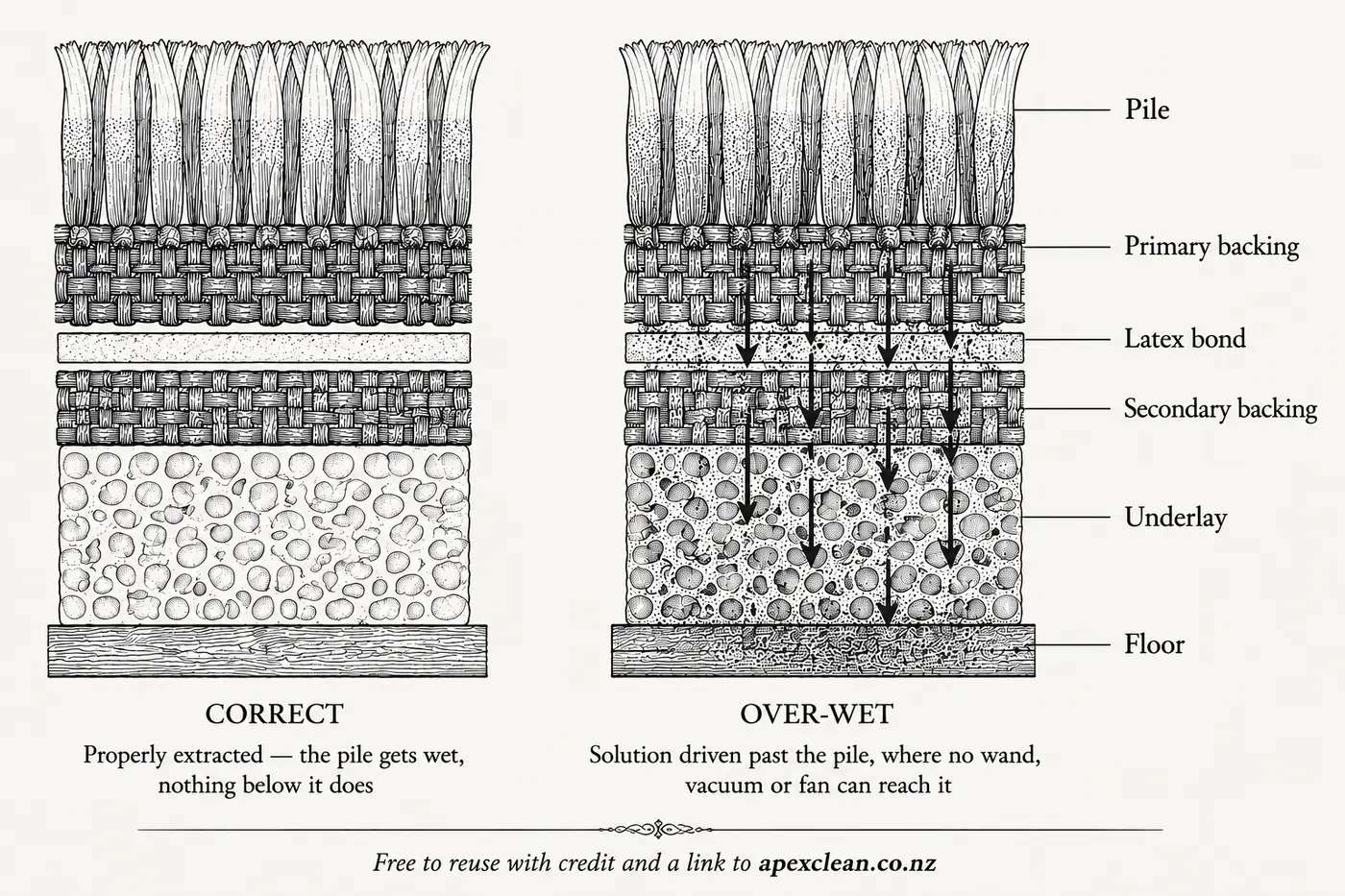
Cleaning is meant to be a fast round trip. Solution goes into the pile, breaks the soil loose, and gets pulled straight back out. The pile gets wet. Nothing underneath it does.
Pressure is what puts the solution in. That is its entire job.
Now think about what happens as you increase it. The pile is a few millimetres of fibre — it does not need much to be saturated. Beyond the point where the pile is wet, extra pressure has nowhere useful to go, so it does the only thing left: it drives solution through the pile and into the backing.
That water is now somewhere nothing can reach. No wand reaches it. No vacuum reaches it. No fan reaches it. It has to evaporate out on its own, upward, through the full thickness of the carpet.
There is a second effect at high pressure. Carpet backing is bonded — a primary backing holding the fibre, a secondary backing bonded to it with adhesive. Sustained high-pressure water works against that bond. When it separates, the carpet delaminates: it ripples, it feels loose underfoot, and it cannot be repaired by cleaning it again.
So pressure past the useful point buys you nothing on the way in, and costs you on the way out.
Damp for days, stains that come back, and a backing that lets go
Three things a homeowner actually notices, all downstream of one setting:
- It stays damp for days. Water in the backing and underlay is not drying from the surface. It is drying through the whole thickness, slowly.
- The stain comes back. Old spills that soaked into the backing years ago dissolve again in all that water, and as the moisture evaporates upward it carries the soil with it to the surface. That is wicking — a moisture problem wearing a stain’s clothing.
- It resoils fast. Damp carpet holds dirt. A carpet that took three days to dry starts looking tired much sooner than one that dried in three hours.
None of those look like a pressure problem when they happen to you. All three are.
Ask what pressure they’ll run — and expect a range, not a number
Ask any cleaner. A good one will enjoy being asked.
- What pressure will you run on my carpet? You want a range rather than one fixed number, somewhere under 500, and you want them to know why.
- Can your machine adjust pressure? Some can’t meaningfully. A machine with one setting is a machine making one decision for every carpet.
- What pressure would you use on wool versus a synthetic loop pile? The answer should not be the same.
- What happens if the carpet delaminates?
- What’s your dry time, and what happens if it’s not dry?
We run 200–300 PSI, and never past 500
We work 200–300 PSI on carpet for most jobs, matched to the fibre and the soil, and never go past 500 on any fabric. The machine is rated well above that — the discipline is in not using it.
Which is easy to say when your machine can’t do more. Ours can. The van-mounted hybrid electric system produces up to 600 PSI, and the heater is rated to operate at 1,300–1,500 — we simply never ask for it. Nothing in the system works near its limit, which is what you want on equipment running all day.
That headroom is the point. Every job is a decision to dial back to what the fibre in front of us can take, instead of a machine at full stretch doing the only thing it knows.
We don’t clean tile or grout, and that’s genuinely where four-figure pressure belongs. On carpet the skill isn’t in how much pressure you can produce. It’s in knowing how little you need — and being willing to leave the rest unused.
If you’d rather see the number than be told about it, get your number in 90 seconds. It’s a firm quote, not a call-back.