
How long should carpet take to dry after cleaning?
A few hours for walk-on dry, and fully dry well inside a day. The biggest factor by far is how much water was left in the carpet, not the weather — then airflow, indoor humidity and room temperature, in that order.
Written by Bency John, owner-operator at ApexClean — who does the cleaning as well as the writing.

What actually sets your dry time?
Drying isn’t something that happens to your carpet afterwards. It’s decided while the cleaner is still there.
Weather as the whole explanation
Drying time depends on the weather and the season. In summer it’s quick, in winter it’s slow, and there isn’t much anyone can do about it.
Four things set it, and the first outweighs the other three combined
Four things set your dry time, and they aren’t equal. The first one outweighs the other three combined, and it’s the only one that’s already finished by the time the van leaves.
| Factor | How much it moves the number |
|---|---|
| How much water was left in the carpet | Hours vs days. Decided by the operator |
| Airflow across the surface | Hours. Yours to control |
| Indoor humidity | Hours. Partly yours |
| Room temperature | The smallest of the four |
Weather matters — but it acts through humidity and temperature, which are the two weakest levers. That’s why “it’s winter” doesn’t explain a carpet that’s still wet on Tuesday.
How long does it take for wet carpet to dry?
It depends entirely on how wet, and the two cases are nothing alike.
- After a properly extracted clean — walk-on dry in 2–4 hours, fully dry within the day. The pile is damp; nothing underneath is.
- After an over-wet clean — 1–3 days, because water sat in the backing where no wand, vacuum or fan can reach it. It has to evaporate upward on its own. → Why is my carpet still wet two days later?
- After a flood, burst pipe or genuine soaking — 3–5 days with proper equipment, and considerably longer without. Underlay holds far more water than carpet does, and a wet slab underneath will keep re-wetting everything above it. This is a drying job, not a cleaning job — different equipment, and the clock is the thing that matters. → Water damage restoration
The rule of thumb: if it isn’t dry within 24 hours, the problem is water that was left behind, not the weather.
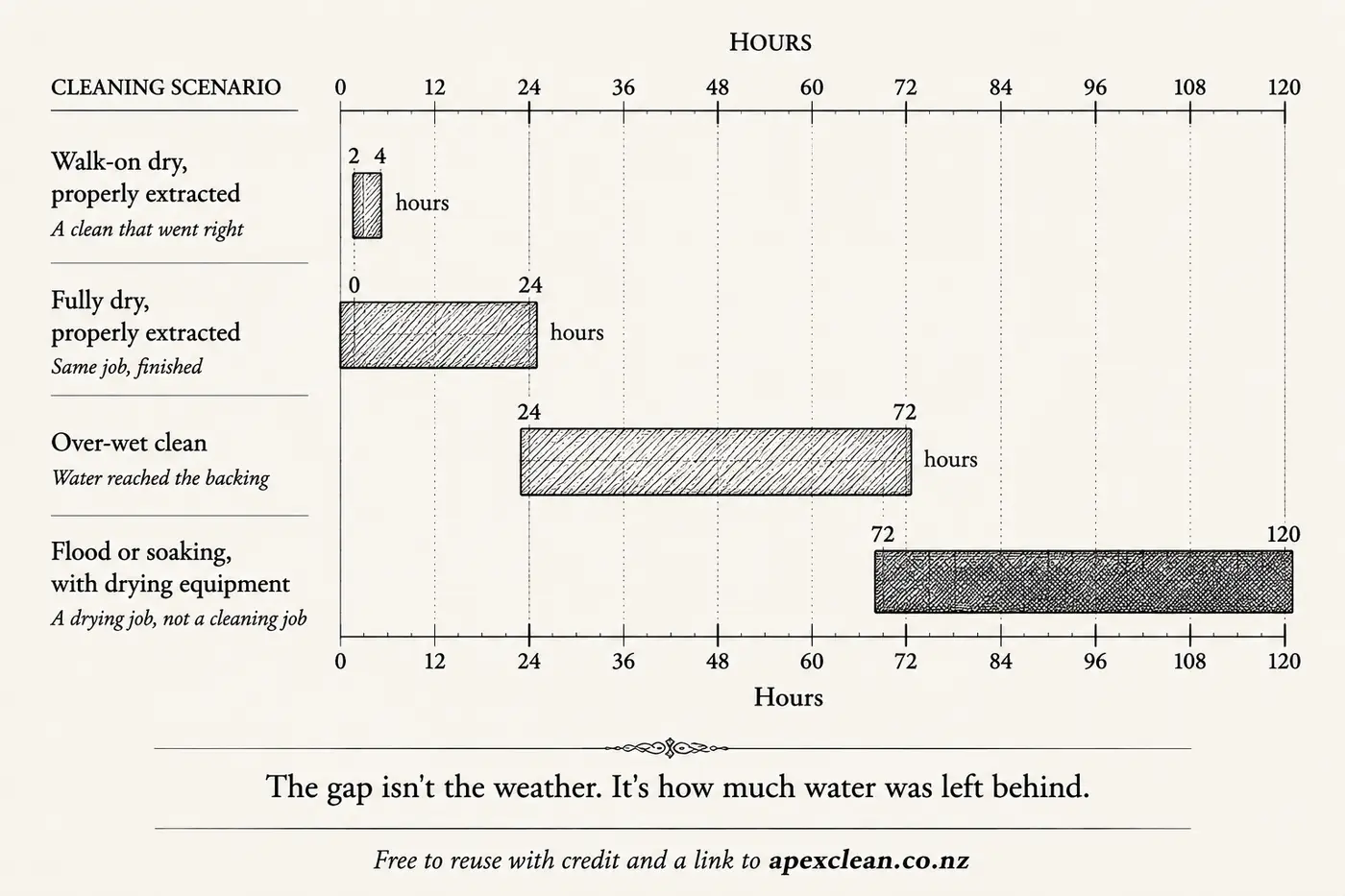
Water in the pile leaves in hours. Water in the backing can’t be reached
1. What’s left behind — the one that matters
Water sitting in the pile can be reached by moving air, and it goes in hours. Water driven below the pile into the backing and underlay cannot be reached by anything, and has to evaporate upward through the full thickness of the carpet.
That’s the difference between three hours and three days, and it was determined before anyone opened a window. → Vacuum: the number nobody talks about · Can carpet be over-wet?
2. Airflow — the biggest thing you can control
Evaporation stalls when the air immediately above the carpet becomes saturated. Once that layer is holding all the moisture it can, drying nearly stops — no matter how warm the room is.
Moving that air away is what restarts it. This is why a fan does more than a heater, and why a closed room dries badly even in summer.
- A pedestal fan aimed low across the floor, not down at it, does most of the work
- Two doors open creates a path; one open door creates very little
- Ceiling fans help, extractor fans help
- A dehumidifier is excellent if you have one
3. Humidity — why Auckland is its own case
Air can only hold so much moisture, and warm humid air is already carrying a lot. On a muggy Auckland day, opening the windows can make drying slower, because you’re bringing damp air in.
The counter-intuitive rule: on a humid day, close the windows and run a fan or a dehumidifier. On a dry, breezy day, open everything.
4. Temperature — real, but the smallest lever
Warmer air holds more moisture so it can accept more from the carpet. But heat with no airflow just makes warm saturated air sitting still. Heating a closed room is the least effective of the four.
How to dry damp carpet faster — what actually helps, in order
Every one of these is free or nearly free, and the order matters more than the effort.
- Airflow. A fan across the floor. The single most useful thing you can do.
- Move the air out. Open two windows on different sides, or run an extractor.
- Keep traffic off. Walking on damp carpet pushes moisture back down into the backing.
- Leave furniture off until it’s dry — protectors under legs if it must go back.
- Dehumidifier if it’s a humid day or a closed room.
- Heat pump on dry mode — better than heating, because it removes moisture.
Damp carpet resoils before you’ve walked on it
- Damp carpet resoils faster. The clean starts degrading before you’ve walked on it.
- Slow drying is when stains wick back. More days damp, more soil travelling upward. → Why did my stain come back?
- Smells establish in damp carpet and pass in one that dried fast. → Why does my carpet smell worse?
- Days of damp risk the layers underneath, not just your patience.
Ask what happens if it isn’t dry in the time quoted
- What dry time are you quoting for my carpet, in my conditions?
- What happens if it isn’t dry in that time?
- How many dry passes will you do at the end?
- Do you use air movers, or do you leave it to the room?
- What should I do after you leave? A cleaner who gives you a proper answer has thought about the outcome, not just the appointment.
We spend the effort at the only end that counts
We spend the effort at the only end where it counts — getting the water out before we leave, rather than hoping the room does it for us. Slow dry passes with nothing running but suction, hose runs kept short so the extraction reaching your floor is close to what leaves the van, and pressure matched to the fibre so less water goes below the pile to begin with.
That’s what makes walk-on dry in 2–4 hours a working expectation rather than a best-case.
Then we tell you what to do with the room — usually a fan and two open windows, or on a muggy day, windows shut and a fan running. It’s ten seconds of advice that can halve the number, and it costs nothing to give.
If it’s not drying the way we said it would, tell us. That’s a fault, not a forecast.