
Can carpet be over-wet during cleaning?
Yes. Once water passes through the pile into the backing and underlay, nothing can extract it and it has to evaporate out over days. That can delaminate the carpet, saturate the underlay and allow mould. Over-wetting is the most common avoidable fault in carpet cleaning.
Written by Bency John, owner-operator at ApexClean — who does the cleaning as well as the writing.

What happens when carpet gets too wet?
A carpet can absolutely be over-wet — and every consequence of it happens somewhere you can’t see.
If water is the cleaner, more must be better
Water is the cleaning agent, so more of it means a deeper clean. You can’t really overdo it — it’s only water, and it dries.
Water is the carrier, not the cleaner — and it has to come back out
Water is a carrier, not the cleaner. Its job is to suspend soil and then leave again, taking the soil with it. Water that goes in and doesn’t come back out isn’t cleaning anything. It’s just sitting there causing problems.
And the problems it causes are structural, not cosmetic. The pile is fine. It’s what’s underneath that suffers.
Past the backing, water stops cleaning and starts delaminating
A carpet is a primary backing holding the tufts, a secondary backing bonded to it with latex adhesive, and usually an underlay below that.
A properly executed clean wets the pile and very little else. Over-wetting drives solution through the primary backing — and from there it’s out of reach of every tool that exists. No wand, no vacuum, no fan.
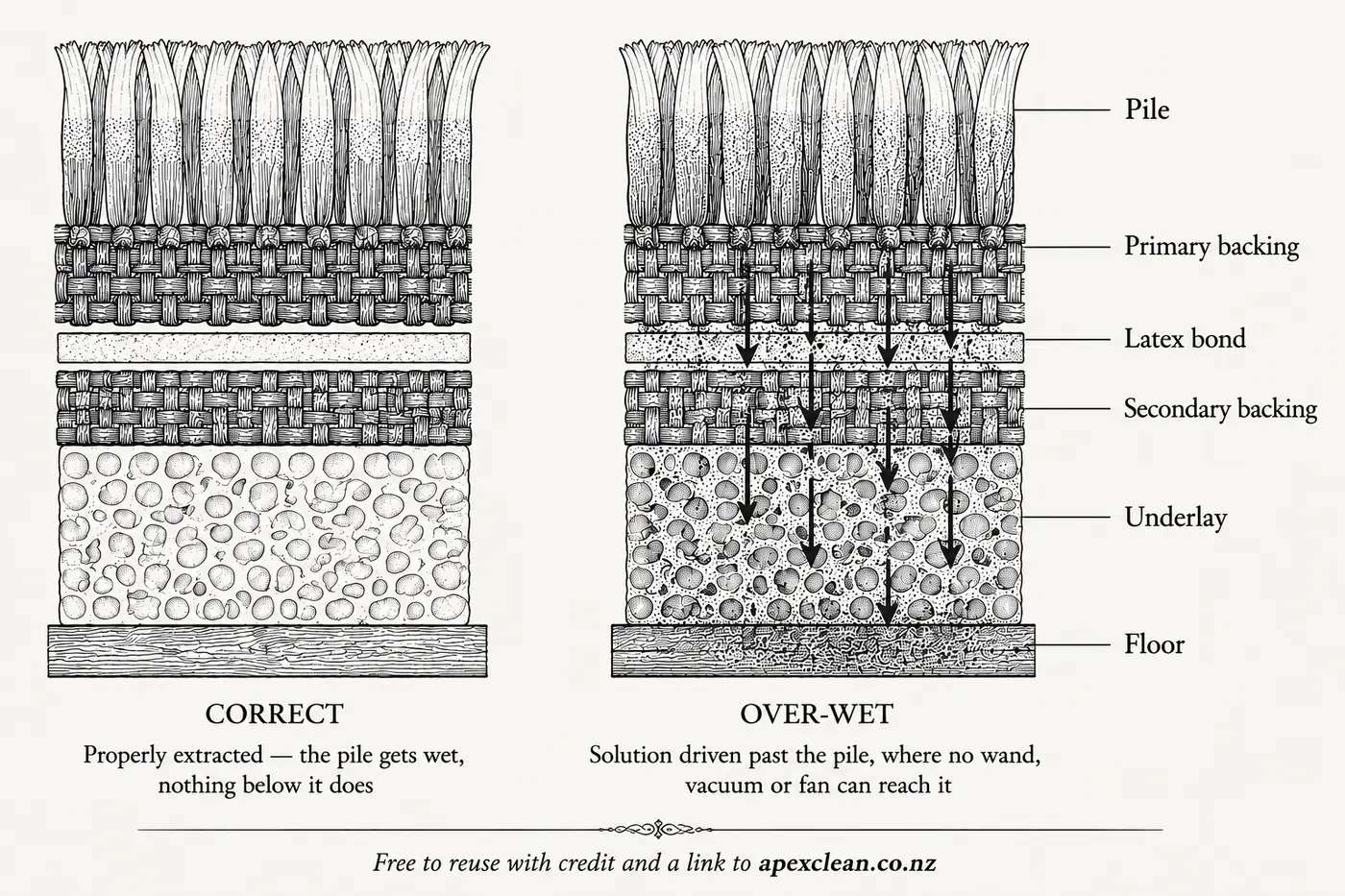
What too much water actually does
Delamination. Sustained wetting works against the latex bond holding the two backings together. When it lets go, the carpet ripples, feels loose underfoot and lifts away from itself. It cannot be cleaned back into shape — it’s a repair or a replacement.
Underlay saturation. Underlay is foam or rubber crumb designed to be dry. Wet, it holds moisture for days, compresses differently underfoot, and can break down over repeated soakings. It’s also the layer nobody inspects until the carpet is lifted.
Wicking. Old soil down in the backing dissolves in the standing water and travels up as it evaporates, surfacing days later as a stain. → Why did my stain come back?
Odour. Bacteria dormant in a dry backing become active in a damp one. → Why does my carpet smell worse after cleaning?
Mould, in the worst cases. Given enough days of damp and poor airflow, mould can establish under a carpet. It’s uncommon from a single over-wet clean and it is not impossible — and it starts in the layer nobody looks at. Drying a wet structure fast enough to stop that happening is the entire subject of the industry’s water-damage standard, IICRC S500.
Shrinkage on natural fibres. Wool and some natural-backed rugs can shrink when saturated, pulling away from the walls.
What causes it
Three things, all decided by the operator on the day:
- Too much pressure, pushing solution past the pile → Does higher PSI clean better?
- Too little extraction — what goes in doesn’t come out
- Too much hose, which is the same fault by a different route → Why long hose runs leave your carpet wetter
Notice that none of them is the carpet’s fault, the weather’s, or yours.
Both carpets look clean the day the van leaves
- The visible result looks identical on the day. An over-wet carpet and a properly extracted one both look clean when the van leaves. The difference emerges over the following week.
- The expensive consequences are the invisible ones. Delamination and underlay damage cost far more than any clean.
- It’s cumulative. A carpet over-wet at every clean ages faster than one that isn’t.
- “It’ll dry eventually” is not reassurance. Everything on this page happens while it’s drying. The length of the wet period is the risk.
Ask how wet it will be when they go — “damp” is the right answer
- How wet will the carpet be when you leave? Damp to the touch is the right answer. Wet is not.
- How do you avoid getting water into the backing?
- What’s your dry time, and what happens if it’s not met?
- Do you use air movers, or is it just left to dry?
- Is there any risk of shrinkage on this carpet? Especially worth asking on wool.
We spend less water, and recover what we spend
We treat water as something to be spent carefully and recovered completely.
Heat does more of the work, so less water and less chemistry are needed to begin with. → The maths on why heat does that
Pressure stays matched to the fibre rather than turned up, so solution stays in the pile where it belongs. And the job finishes with slow dry passes — extraction with nothing running but suction — which is the least interesting part of the day and the part that decides everything above.
Walk-on dry in 2–4 hours isn’t a convenience claim. It’s the evidence that the water went in, did its job, and came back out again.