
Reference · Updated 6 August 2026
The numbers in a carpet cleaning quote, explained.
Every carpet cleaner quotes numbers. Almost nobody says what they mean, where they were measured, or what a normal one looks like. This page does — with the honest ranges, the sources, and the vocabulary the industry uses without defining.
In short
Four numbers decide a carpet clean, and only one of them usually gets advertised. Pressure belongs between roughly 200 and 500 PSI on carpet — higher is a hard-floor figure, not a better clean. Temperature is only meaningful if you know where it was measured, because water sheds heat between the machine and the floor. Vacuum is the one nobody prints, and it decides how much water is left behind. Dry time is the result of all three — a few hours if the water came back out, days if it didn't.
Pressure (PSI)
Jet pressure — how hard solution is pushed into the pile. It is the number most often used as a selling point, and the one most often misapplied.
| Figure | What it actually is |
|---|---|
| 200–300 PSI | The conservative residential range — delicate fibres, wool, older carpet. |
| 400–500 PSI | Typical wand work on robust synthetic carpet. Most residential cleaning lives here. |
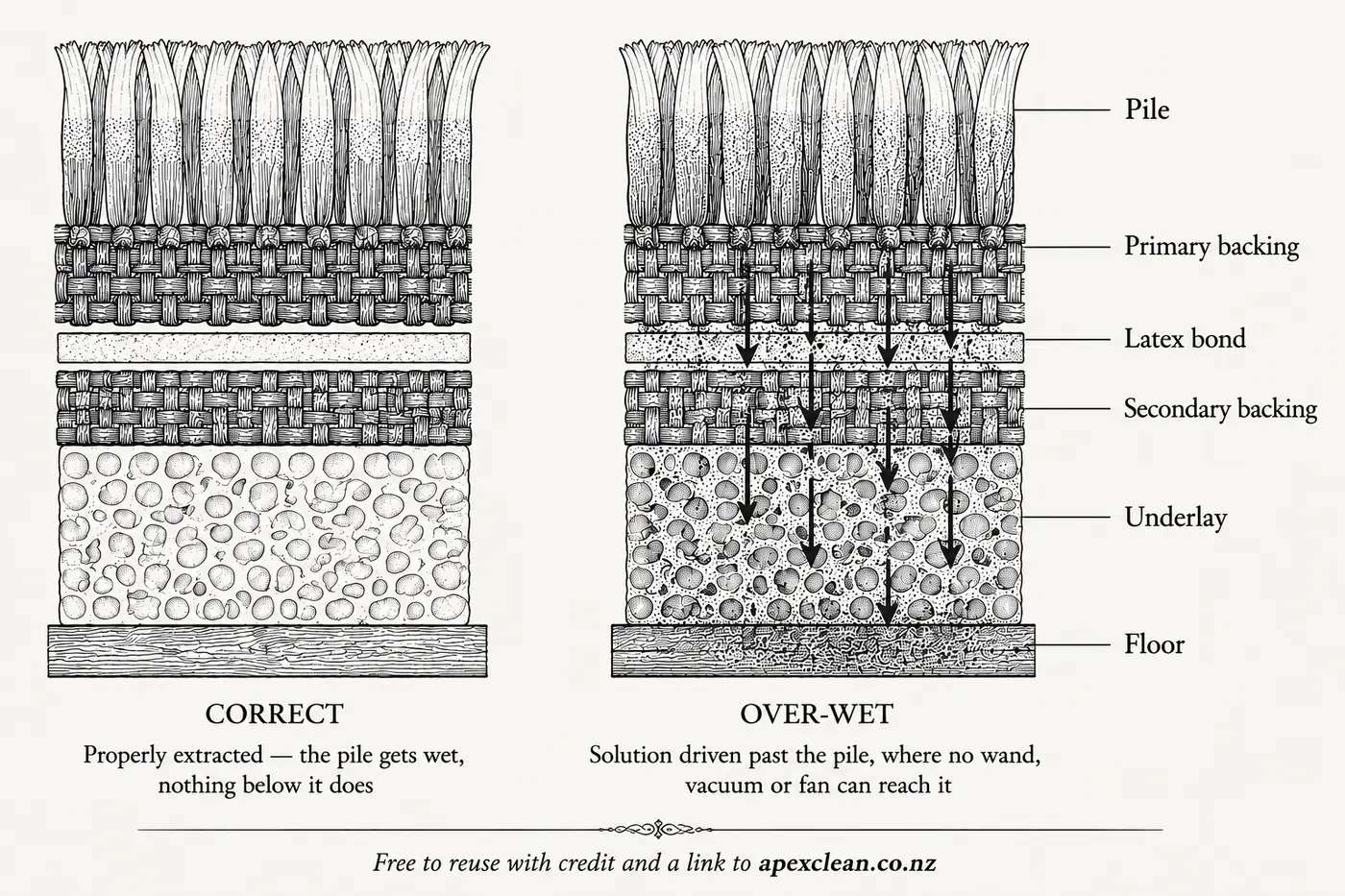
| Above 500 PSI | Rarely a reason on any fabric. Past this you stop lifting water out and start driving it into the backing — the cause of slow drying, wicking and delamination. |
| 1,000+ PSI | A hard-floor figure. Tile and grout genuinely want it. On carpet it is not a stronger clean, it is a different job — and a machine advertising it isn't wrong, it's just describing work that isn't yours. |
Working ranges reflect general industry practice and our own daily use. They are not quoted from IICRC S100 — we haven't read the standard's text and won't attribute a figure to a document we can't quote.
Temperature (°C)
Heat does real, measurable work — but a temperature is meaningless without the place it was measured. Water sheds heat continuously between the machine and your floor.
| Figure | What it actually is |
|---|---|
| ×2 per 10°C | Chemical action roughly doubles for every 10°C rise — the reason heat means less detergent, less residue and faster drying. Usually quoted from a baseline near 48°C. |
| ~55–60°C | The range above which dust mites do not survive. Relevant to allergen work, and well below what a professional machine produces. |
| Up to 120°C | At the machine. That is a boiler capability, not the temperature meeting your carpet, and it is dialled down to suit the fibre in front of it. Any figure quoted at the carpet is describing something that changes minute by minute. |
| Wool | Takes markedly less heat than synthetic. Olefin less again. Getting this wrong isn't a worse clean — it's permanent damage. |
The doubling rule derives from the work of Svante Arrhenius, Nobel Laureate in Chemistry, 1903. Dust-mite thermal tolerance is well established in the allergen literature. Note: the CRI preconditioning white paper is frequently mis-cited for temperature figures — it contains none.
Vacuum — the number nobody prints
Cleaning is finished by what comes back out, not by what goes in. Vacuum decides that, and it is almost never quoted — partly because two different measurements are involved and neither survives a long hose.
| Term | What it measures |
|---|---|
| Waterlift | Sealed suction, in inches of water column — pulling power against resistance. This is what drags moisture out of a dense, saturated backing. |
| CFM | Airflow volume with the airway open. Moves air, and with it evaporation. A machine can be strong in one and weak in the other. |
| Hose length | Both figures fall away over distance, and the loss accelerates. A van parked down the street delivers a fraction of its rated extraction to your lounge — and nothing about it looks different while it's happening. |
We don't publish our own CFM or waterlift figures. We haven't measured them under conditions we'd be willing to stand behind, and a number invented for a spec sheet is exactly what this page exists to argue against. What we will tell you is how much hose we're running, which is the part that actually changes your result.
Dry time (hours, or days)
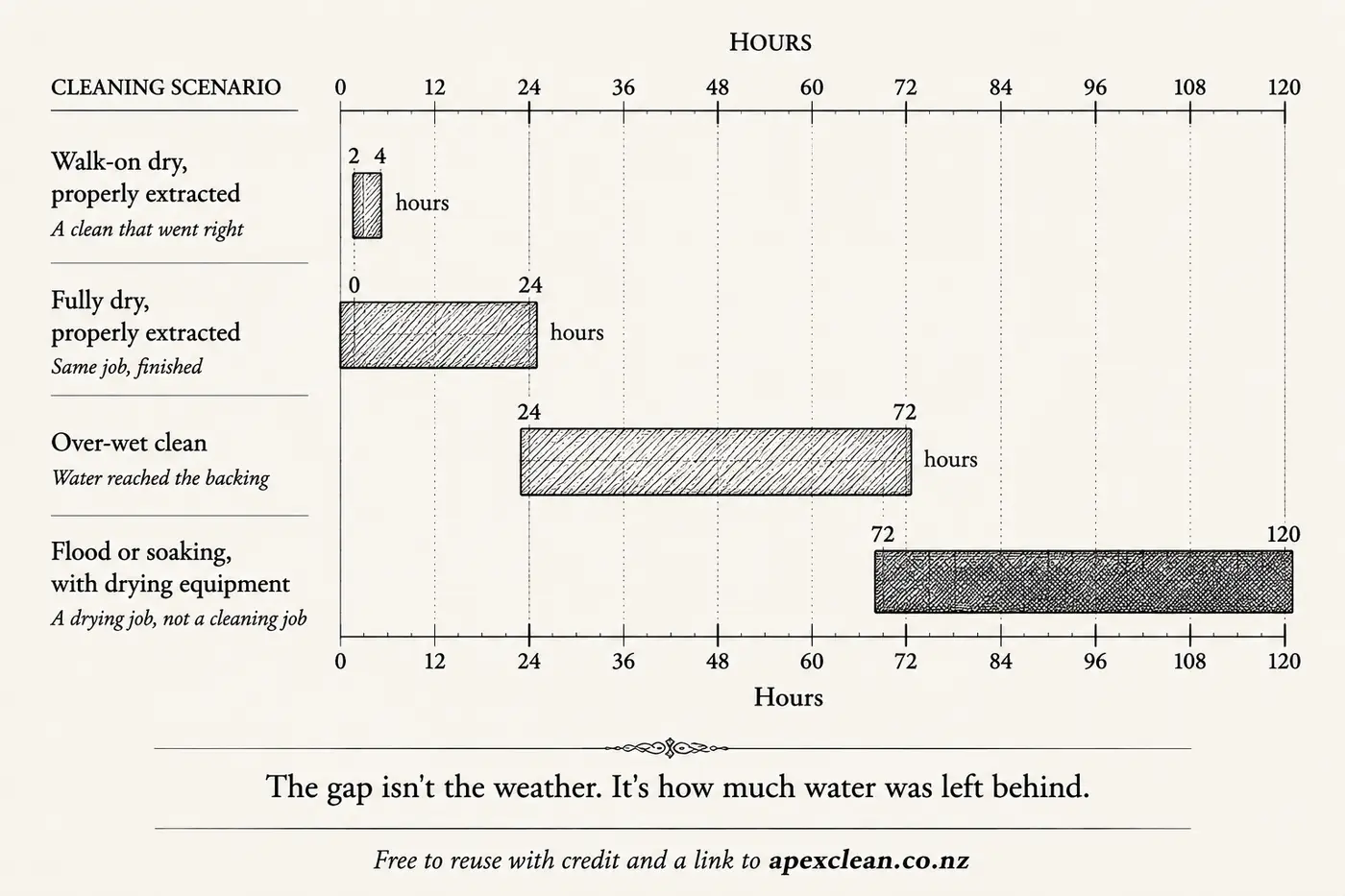
Not a weather number. Dry time is mostly decided before the van leaves, by how much water was left behind.
| Figure | What it actually is |
|---|---|
| 2–4 hours | Walk-on dry after a properly extracted clean. The pile is damp; nothing underneath is. |
| Within 24 hours | Fully dry. Past this point the problem is water left in the backing, not the season. |
| 1–3 days | An over-wet clean. Water reached the backing, where no wand, vacuum or fan can retrieve it. |
| 3–5 days | A genuine flood or soaking, with proper drying equipment. Considerably longer without. |
Soil and chemistry
The least visible numbers on this page, and the ones that decide how much soil actually leaves your carpet.
| Figure | What it actually is |
|---|---|
| 74–79% | The proportion of carpet soil that is dry particulate — grit and fibre that lifts out before any water is involved. It is why a thorough dry vacuum comes first. |
| 3.54× | How much better chemistry cleans when sprayed on and given time to work, versus the same product used only in the machine's tank. |
| 4.6% | How much better detergent used only in the tank performs than plain hot water. Almost nothing — which is the point. |
| 10–15 min | Typical dwell time. Ten minutes where nothing appears to be happening, and the easiest step in the job to skip. |
Soil-removal figures from Carpet Preconditioning: Its Impact on Cleaning, a white paper compiled for The Carpet and Rug Institute by Gary Asbury (Professional Testing Laboratory) and Jeff Bishop (Clean Care Seminars), measuring soil removal by spectrophotometer against the AATCC gray scale. Dry-particulate proportion from DuPont and other industry surveys.
The words, defined
Terms that appear across this industry — including on our own pages — usually without anyone stopping to say what they mean.
Hot-water extraction (HWE)
The method almost everyone calls "steam cleaning". Heated water and cleaning solution are sprayed into the pile and immediately vacuumed back out, carrying the suspended soil with them. It is not dry steam — the water is liquid when it meets the carpet.
Pre-spray / preconditioning
Cleaning solution applied to the carpet and left to work before extraction begins. It is the single largest controllable factor in how much soil actually leaves.
Dwell time
How long the pre-spray is left in contact with the soil before it is extracted. Typically 10–15 minutes. Invisible to the customer, and the first thing cut when a day is overbooked.
Dry pass
A pass of the wand with suction only and no solution running. It is where the water actually leaves the carpet, and it is the difference between dry in hours and damp for days.
Wicking
Soil or staining that has soaked deep into the backing dissolving in leftover moisture and travelling back up to the surface as the carpet dries — reappearing days after a clean that looked perfect. It is a moisture problem, not a stain problem.
Delamination
The latex bond holding a carpet's two backing layers together breaking down, usually after sustained wetting. The carpet ripples and lifts away from itself. It cannot be cleaned back into shape — it is a repair or a replacement.
Waterlift
A vacuum's sealed suction, measured in inches of water column: how far it can lift a column of water with the airway blocked. It describes pulling power against resistance — getting moisture out of a dense, saturated backing.
CFM (cubic feet per minute)
Airflow: the volume of air a vacuum moves when the airway is open. Waterlift and CFM measure different things and a machine can be strong in one and weak in the other. Both fall away over hose length, which is why the figure on a spec sheet is not the figure reaching your floor.
Jetting
The spray of solution from the wand's jets into the carpet. Jet pressure is the PSI figure people quote.
Low-pH / conditioning rinse
A slightly acidic final rinse that neutralises alkaline pre-spray so no sticky detergent is left behind attracting new soil. Also important on wool, which dislikes high alkalinity.
Traffic lane
The visibly darker path worn through a room. Usually abrasion and embedded grit rather than staining, which is why it responds to a proper clean but rarely returns to new.
What we actually run
For completeness, since this page asks everyone else to be specific. Our system is a van-mounted electric extraction unit with a separate LPG-fired heater — heat that doesn't compete with the vacuum and pump for power, so it holds across a whole house rather than fading in the last room. The extractor is a Hydro-Force Nautilus MX3-500 Extreme, which carries the Carpet & Rug Institute's Platinum Seal of Approval — their top deep-cleaning tier, and a thing you can look up rather than take our word for.
Temperature: up to 120°C at the machine, dialled to the fibre. Pressure: the machine is rated to 600 PSI; on carpet we work 200–300 for most jobs and never go past 500 on any fabric — the headroom is there so the pressure never has to be forced, not so it gets used. Hose: 10–30 m wherever we can park close, 50 m as a hard maximum — the shorter the run, the more suction reaches your floor. Vacuum figures: not published, for the reason given above.
We don't do tile and grout, so we have no use for a four-figure PSI number — and we'd rather say that than let a spec sheet imply otherwise.
The full method, step by step → · All 19 guides → · Carpet pile types →